THE CLAIM
A complex death is reduced to a simple headline: "kratom." Not the co-drugs. Not the medical history. Not the product-form uncertainty. Just one word.
Open Truth: independent public-record analysis for educational purposes. Individual case interpretations should not replace professional medical or legal advice.
A national campaign is turning complicated deaths into simple slogans. Open Truth puts the facts back on the table.
Open Truth is a public-record evidence bank built to track what happens after a death enters the political system. Not the press release. Not the hearing soundbite. Not the clipped quote repeated on television. The record.
Because the pattern is consistent: a complicated death gets reduced to one word, the missing context gets stripped away, the emotional version gets amplified — and the law gets written against a broader product than the record actually supports.
A complex death is reduced to a simple headline: "kratom." Not the co-drugs. Not the medical history. Not the product-form uncertainty. Just one word.
The hardest facts disappear first: autopsy detail, toxicology nuance, medical history, scene evidence, product type, concentration limits, and co-drug context.
The simplified version spreads because it is easier to repeat. Media repeats it. Advocates package it. Legislators hear the emotional version instead of the full record.
Once the simplified story hardens into public truth, policy follows. And ordinary adults using a different product than the one actually at issue become collateral damage.
Before a death is used to justify a bill, a ban, or a hearing, the record should clear three tests.
Finding mitragynine in a postmortem sample does not automatically prove that natural kratom leaf caused death. A toxicology report is not a headline. It is a puzzle.
Mitragynine might be in the report — but what else was in their system? What does their medical history show? What did the public summary leave out? A single substance is rarely the whole story; the omissions usually are.
Families deserve compassion. Lawmakers still owe the public accuracy. A grieving parent can explain why a bill was introduced — but not replace the autopsy, toxicology, or source record.
Not a list of enemies. A map of how a death becomes a bill — and what gets left out on the way.
Read the toxicology. Read the case studies. Look at the data. Then decide what should regulate kratom.
Bills should be written from the record, not the panic. The advocacy groups should not be propelling the story past the file — the file should be setting the standard for the regulation.
Open Truth is not asking anyone to pretend all kratom products are risk-free. They are not. We are not defending contaminated products, reckless vendors, misleading labels, concentrated 7-OH, or synthetic derivatives sold under botanical branding.
Those products deserve scrutiny and enforcement. Some deserve removal from the market. That is exactly why the truth matters.
Because when lawmakers collapse natural leaf, concentrated 7-OH, extracts, contaminants, prescription-drug interactions, alcohol, fentanyl, antidepressants, antihistamines, heart disease, seizure disorders, and postmortem toxicology uncertainty into one word — kratom — the law stops protecting the public and starts punishing the wrong people.
The answer is not panic. The answer is proof.
Read the autopsy. Read the toxicology. Read the bill. Read the source file. Then ask the question every lawmaker should have asked first: What actually killed them?
A big flaw in Matthew's Law: a four-substance toxicology turned into a one-word headline. The law named for a death is not honest about what the toxicology actually showed.
Karen Davenport's advocacy helped turn Matthew Davenport's death into a legislative symbol. The public story became simple: kratom killed Matthew. But the toxicology record is not a one-substance story. The most obvious red flag is not the compound that made the headline — it is the Benadryl level.
"Kratom killed my son."
— Public testimony & legislative advocacy preceding Matthew's Law.
The toxicology shows diphenhydramine at 3,000 ng/mL — a fatal level — alongside duloxetine (320 ng/mL), buspirone (100 ng/mL), and mitragynine at a non-fatal 810 ng/mL.
Matthew Davenport's death is a tragedy. No one disputes that. But the story being told to Tennessee lawmakers leaves out critical facts from his own toxicology report — and those facts change everything about this bill.
WHAT THE CHART SHOWS: Diphenhydramine — sold over the counter as Benadryl — was at a fatal level. Mitragynine was detected at a non-fatal concentration. The law named for Matthew Davenport criminalizes the lowest-impact compound on the page.
A four-substance toxicology should not become a one-substance criminal statute.
"Did the public hear the whole truth?" Each card compares the public story with the toxicology and pathology context found in the underlying materials. The goal is not to diminish grief. The goal is to stop grief from being weaponized through selective storytelling.
These are not trading cards. They are record cards.
Each one tests a public claim against the underlying toxicology, pathology, product form, scene context, medical history, and competing causes.
The goal is not to diminish grief. The goal is to stop grief from being converted into selective storytelling.
KRATOM
KILLED
THEM.
The file may not show whether the exposure was natural leaf, extract, enhanced product, or concentrated alkaloid.
Was it natural leaf, an extract, an enhanced product, or concentrated 7-OH?
The claim gets one word. The record gets the last word.
"Mitragynine detected" is being read as "kratom caused death." But detection is not proof. A label is not an explanation.
The campaign sells a single image: a Christian-educated college athlete whose life was destroyed by a tea leaf. The facts tell a different story — nine years of criminal cases, traffic charges, alcohol programs, crashing into trees, and court appearances the legislative testimony does not mention.
— A single-cause narrative is the easiest story to tell. It is not the one in the docket.
Lynchburg General District Court. Traffic infraction filed during his time at Liberty — the same year the campaign claims kratom first entered his life. The story of the "pristine Christian athlete" begins here, in a courthouse.
Cameron crashed his car head-on into a tree and fled the scene. Police arrived at his parents' door looking for the missing driver. The incident reportedly led to Alcoholics Anonymous.
Originally charged with petit larceny under §18.2-96. Amended to trespass after forbidden under §18.2-119. Case continued seven times over eleven months — by agreement, by defendant, by "other" — before final dismissal in June 2021.
Failure to obey a traffic signal. He did not appear in court. He was convicted in his absence and fined.
DWI 1st offense. Convicted. Six-month sentence (suspended), twelve-month license suspension, ignition interlock, VASAP, $250 fine, $224 in costs. During the exact period the campaign claims kratom alone was destroying his life.
Same arrest. Same officer. Separate charge: drinking while driving with an open container under §18.2-323.1. The charge a person picks up for actively drinking liquid alcohol behind the wheel. Nolle prosequi — dismissed after he pled guilty to the DWI.
Less than two months after the DWI conviction: a show-cause summons for failure to comply with court conditions. Continued, then dismissed. The conviction was three weeks old and he was already back in court for not following through on it.
Convicted. 90-day sentence suspended, twelve months of unsupervised probation, $87 in costs. The most recent criminal conviction in the file.
Filed this year. Hearing scheduled March 4, 2026. The court record isn't a closed chapter — it's still being written, even as his father testifies that the kratom story is fundamentally about a tea leaf.
The audio/video record you’ll find here as evidence widens the gap between reality and Dean’s public narrative. Review the evidence below and see for yourself.
The kratom industry hates my son's story because it has nothing to do with extracts or liquid shots… His addiction, like many people, was strictly the ‘kratom leaf’ in powder form.
Audio, video, court files, and family interviews on this page document bottles, extracts, 7-OH tablets, alcohol convictions, and repeated treatment — not a clean “natural leaf” case.
HEAR THE AUDIO
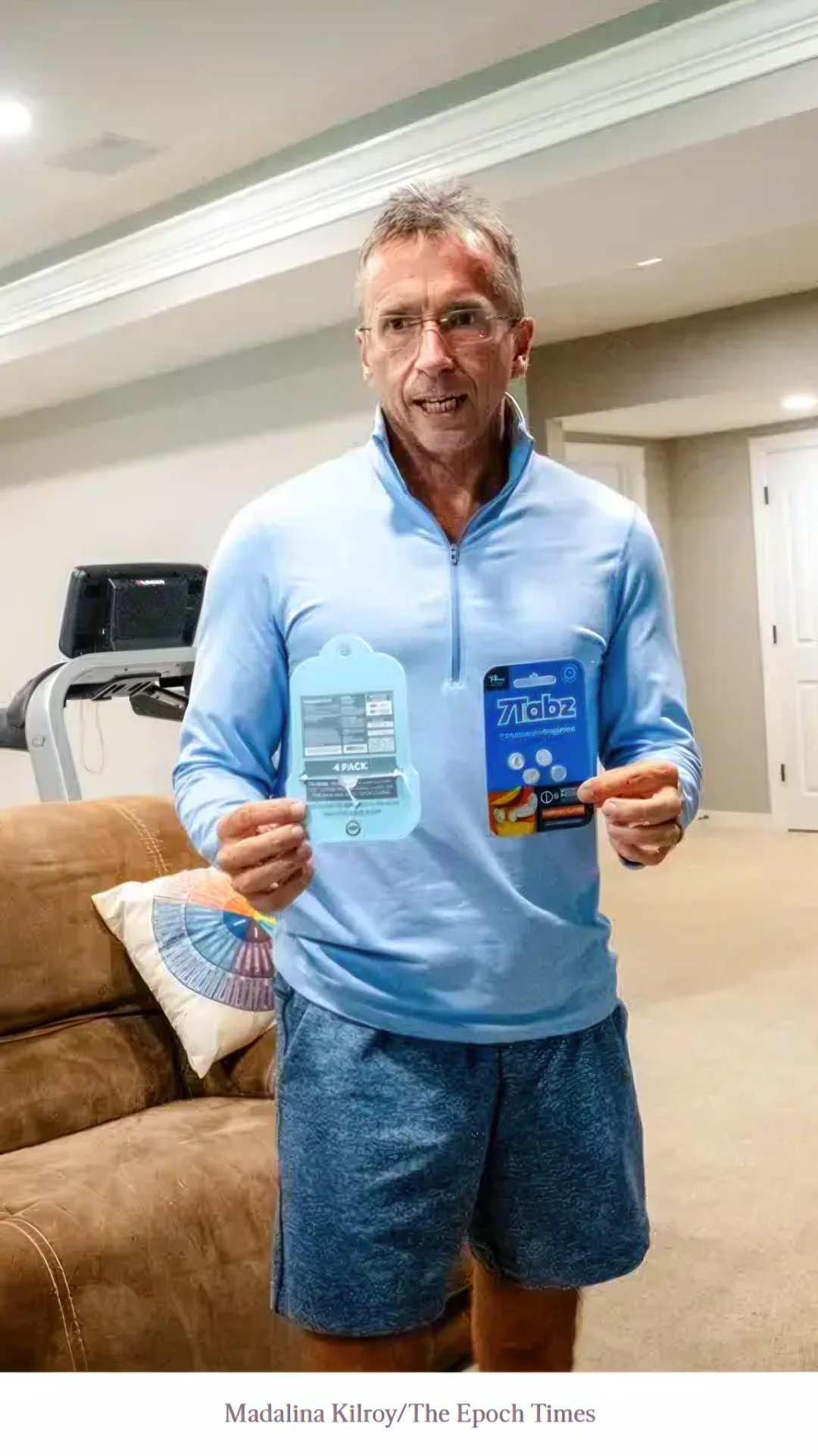
In an Epoch Times article photo, Dean is using concentrated synthetic 7-OH to describe his son’s addiction. He only later adopted a hardline stance against natural kratom during his advocacy efforts.
Anytime I felt judged… or I was upsetting someone because of my choices, it made me want to dive deeper into addiction.
His own public statements suggest that shame, judgment, and interpersonal conflict may have played a significant role in his alcoholism.
SEE THE TIMELINECameron has admitted symptoms of social anxiety and a history of dealing with them through alcohol. On that, the record is fairly clear.
On Dec. 1, 2019, two police officers showed up at the Francis home during the wee hours. A vehicle registered to that address had wrecked head-on into a tree nearby.
2019 was the first documented chapter of Cameron’s relationship with alcohol. His past speaks for itself — is that why Dean isn’t bringing it up? The public deserves to see the entire record.
SEE THE TIMELINEThis April 2026 911 call, Dean Francis smells the alcohol and sees the bottle, yet insists his son is in psychosis from concentrated synthetic 7-OH — while, in the background, Cameron refutes him.
OPEN TRUTH · THE FULL RECORD · 2014–2026
Dean Francis blames a plant. But the documented record — court dockets, body-worn camera, medical files, and a 911 call — tells a different story. One that begins with alcohol, years before kratom enters it, and never stops.
Cameron graduates high school and runs cross country at Liberty University. The family will later frame this as the portrait of a disciplined, high-performing athlete — the “before” the campaign is built on.
Liberty University running records · Big South
At the 2016 Big South meet his 8K time collapses — roughly a minute and fourteen seconds slower, a drop no healthy elite runner posts. A full year before the kratom origin story, the slide is already on the record.
He found kratom in 2017 while searching online for an alternative to alcohol that would help him feel social at parties.— Family account, The Epoch Times
To need “an alternative to alcohol,” alcohol had to already be the problem. The family’s own founding anecdote places drinking before the leaf — and shows Cameron sought kratom out deliberately, not as an unwitting victim of a product.
Lynchburg General District Court · Sep 28, 2017
An “improper mirror” traffic infraction — minor, and dismissed. It matters only as a marker: the documented court trail begins here, the same year as the kratom origin story.
The family says Cameron left Liberty in 2018 after conflict with a new running coach, intending to pursue music — a clean, sympathetic reason for stepping away.
The performance collapse predates the coaching change by two full years. The “rift” compresses a longer pattern of disruption into a single, tidy cause — and leaves the disciplinary and personal context out.
Family Account · The Epoch Times
A late-night head-on crash into a tree. Cameron leaves the scene; police arrive at his parents’ door looking for the “missing driver,” reportedly noting alcohol is typically involved. It leads to Alcoholics Anonymous — and the family admits this one themselves.
When the family tells it themselves, the 2019 crisis is alcohol — AA, a fled scene, a missing-driver call. The record adds nothing the campaign hasn’t already conceded. The one year both sides narrate, the cause is alcohol.
Powhatan Sheriff’s Office · Body-Worn Camera (FOIA, June 2026)
During the July 2020 stop — in the same breath as “satisfy the alcoholism” — Cameron volunteers on camera that he is already “in a program right now.” By his own words, a substance-abuse treatment episode is underway in 2020 — years before the public account frames treatment as a kratom-era development. Open Truth does not have the program’s records; the type and dates are not established here.
Powhatan Sheriff’s Office · Incident #20-009182 · Body-Worn Camera (FOIA, June 2026)
On July 22, 2020, Cameron loads three 42-oz Icehouse beers and jerky into a book bag at a Sheetz and walks out — then comes back and pays $5.30 for tobacco, so he had money. A deputy traces the Jeep to the family home, where he admits the theft and pulls the still-cold beers from his backpack. In the report: “he has an alcohol problem and does not have money to purchase the alcohol he needs.”
On camera: “...I’ve taken kind of desperate measures to kind of satisfy the alcoholism, I guess.” Deputy: “So you have an alcohol problem.” Cameron: “Yeah.” He volunteers he is already “in a program right now.” He didn’t steal kratom. He stole beer — three years into the period the campaign blames on a plant. The Sheetz manager later said she believed he had taken from the store before.
The beer charge is filed as petit larceny, amended to trespass after forbidden, and dismissed. A December traffic matter ends guilty in absentia. Dismissed matters are shown anyway — the goal is full context, not selective framing.
Powhatan Sheriff’s Office · Body-Worn Camera · Powhatan GDC
March 1, 2021 — a deputy stops Cameron’s Jeep for swerving across both lane lines. The body camera records an open container, field-sobriety tests the deputy marked failed, a breath sample noted as incomplete, and a final reading of .139. This is the exact month his father would later describe as kratom destroying his son. The leaf is nowhere in the video. Alcohol is the whole video.
Conviction: DWI 1st, guilty 2021-06-10 — 12-month license suspension, ignition interlock, VASAP, fine and costs.
Filed alongside the DWI: a separate open-container / drink-while-driving charge, later dropped. An open container is not leaf powder.
The campaign frames the 2021 emergency-room visit as a spontaneous, violent kratom-withdrawal crisis — the leaf turning on him.
Medical report (Epoch Times) · Coleman Institute
The medical report notes Cameron had been prescribed Naltrexone — a medication used to treat alcohol-use disorder — and he then entered the Coleman Institute detox. That is an alcohol-treatment context, not a plain-leaf event.
Weeks after the DWI, a show-cause summons for failing to meet the conviction’s conditions. The pattern doesn’t pause.
Richmond City GDC · disorderly conduct
A disorderly-conduct summons orders him to “continue substance abuse treatment, maintain compliances.” The operative word is continue — the court treats him as already, and long, in treatment.
“...His addiction... was strictly the ‘kratom leaf’ in powder form.”— Dean Francis, public statement
In recorded audio Dean describes Cameron moving “over to the MIT or whatever other bottle... stuff that’s in a bottle” — concentrates, not plain leaf. The leaf-only claim collapses in his own words.
Chesterfield General District Court · Jan 3, 2026 · following too closely
A current traffic matter, shown honestly as unresolved — the record is still being written.
“...goes into a vape shop... ‘Hey, we got this new version of kratom, it’s called 7-OH.’ ...take a couple tablets... the next day you will wake up fully physically dependent...”
By Dean’s own telling, the relapse is a concentrated synthetic 7-OH product — chemically nothing like plain leaf. The “tricky clerk” framing raises a question: if Cameron knew 7-OH wasn’t a clerk’s trick, why call it one? On the same show Dean admits Cameron was already using bottled concentrates — so this wasn’t the first.
WTVR reporting · Feb 2026
WTVR reported Cameron was “finishing up another residential treatment program.” The word that matters is another — one more episode in a treatment history the public timeline keeps presenting as new.
Publicly, the campaign’s position is that natural kratom leaf is dangerous enough to outlaw nationwide.
Contemporaneous family account · March 2026 · Mexico
For Cameron’s recovery, the family turned to ibogaine — a Schedule I psychoactive the U.S. has not approved, carrying documented cardiac risks and a far thinner safety record than the leaf the campaign is fighting to ban. It had to be done out of the country because it isn’t legal here. By regulatory status and safety history, the substance the family trusted to save their son is the more dangerous one — yet the campaign points at the leaf, not the rescue drug.
Dean tells the dispatcher the crisis is concentrated 7-OH — that Cameron is “psychotic,” in “a complete state of psychosis.” The dispatcher asks whether Narcan is available.
Authenticated 911 Recording · April 1, 2026 · 15:33
On the same call, Dean says Cameron “literally walked into our house with a whole bottle of whiskey,” had “alcohol all over him,” “downed an entire bottle,” and “doesn’t believe he’s been drinking.” That is the caller narrating an alcohol crisis as it unfolds.
Open Truth makes no medical claim here — no diagnosis or toxicology is in evidence, and we do not assert what was in Cameron’s system. The contradiction is only the one the recording forces: when alcohol is what the caller describes, why does the father keep trying to blame the situation on concentrated 7-OH?
The kratom claim begins in 2017.
The alcohol record begins earlier — and never stops.
Athletics · Courts · Treatment · Public Claims · 2014–2026
Before the public claim became “strictly the kratom leaf,” the record had already told a different story: alcohol, court files, treatment, product-form shifts, and a bottle admission on tape.
The public version asks the audience to see Cameron Francis as a clean, uncomplicated before-and-after story: disciplined athlete, innocent botanical product, sudden ruin. The fuller record is more complicated.
Before kratom became a public campaign, Cameron’s own timeline included alcohol context, a crash, court records, multiple treatment episodes, relapse narratives, and shifting product-form claims — from plain leaf, to bottles, to 7-OH tablets.
This timeline is not here to mock addiction or inflate minor records. It is here to show why lawmakers should not build policy around a public account that doesn’t share the full story when the documented chronology is far messier than the public narrative suggests.
This is not a character assassination.
It is chronology.
And chronology matters when a family story becomes a bill.
Some events were minor. Some were dismissed. Some resulted in guilt. Some are family accounts. Some are public claims. Some are source-on-file materials. That is the point.
The public account is not complete. The record is different. Once the full timeline is visible, Cameron Francis is no longer a clean, single-cause policy case study — he is a complicated addiction-history case being used to argue for laws against millions of adults who were never part of his record.
The timeline does not prove the public story.
It shows how much the public story had to leave out.
On March 1, 2021, a Powhatan deputy stopped Cameron Francis on Route 60 after watching his Jeep swerve across both lane lines. What the body camera recorded over the next eleven minutes is not a man brought down by a botanical. It is a stop in which the deputy's account and the .139 reading do not match the driver's on-camera statements — until a machine ends the argument. Jump to any moment.
One more thing the camera caught almost in passing: Cameron volunteered that he had dropped out of college “a year or two ago” with a year left, and that he had recently been prescribed antidepressants but “stopped doing it.”
A young man consuming alcohol off his prescribed medication, with a .139 reading that did not match his on-camera account — in March 2021, the month later described as kratom-driven. The leaf is nowhere in this video. Alcohol is the whole video.
The machine said .139. The .139 reading was a measurement that exposed Cameron's misleading statements.
On April 1, 2026, Dean Francis called 911 about his thirty-year-old son. Listen to the recording and a remarkable thing happens: the father describes, in detail, a textbook alcohol crisis — and insists, without evidence, that it is something else. This is the same instinct that built the entire EKA campaign, captured live, in real time, in one phone call.
By Dean’s own account on the call, Cameron “literally walked into our house with a whole bottle of whiskey,” had “alcohol all over him,” and “doesn’t believe he’s been drinking.” Dean tells the dispatcher his son downed “an entire bottle.” That is an alcohol emergency, described by the caller, in the caller’s own words.
And yet, again and again, Dean tells the dispatcher his son took 7-OH — that he is “psychotic,” in “a complete state of psychosis,” that “the doctor warned” about it. The dispatcher even asks whether Narcan is available. There is no indication on the call that anyone saw Cameron take 7-OH, tested him for it, or had anything beyond Dean’s assertion. What the recording actually documents is a whole bottle of whiskey and a son denying he drank.
This is the whole campaign in ninety seconds: a father standing over the evidence of an alcohol crisis — the bottle, the smell, the denial — and reaching past all of it to name a different substance, the one his public crusade is built on. We are not going to tell you what was in Dean’s head. We are going to ask the question the recording forces: when the alcohol is right there, why does the father keep saying it is something else?
The bottle was in the kitchen. The father was on the phone, talking about something else.
A grieving father can be sincere and still omit crucial facts.
If the dependence was driven by other substances, why ban the plain leaf?
Dean Francis has become one of the most emotionally compelling anti-kratom voices in the country. His public story is simple: his son Cameron was a disciplined Christian college athlete, introduced to natural kratom leaf, and pulled into years of addiction by a product sold as safe.
It is powerful testimony. It is also incomplete.
Open Truth is not here to mock a father. It is here to ask why lawmakers are being asked to treat one family's edited narrative as scientific proof.
"This was natural kratom leaf. Not extracts. Not liquid shots. Not concentrated 7-OH. Plain leaf."
It is being used to erase the line between traditional botanical leaf and the high-potency products federal regulators are actually targeting.
Cameron's track times appear to insinuate an earlier decline, complicating the "kratom started everything" version.
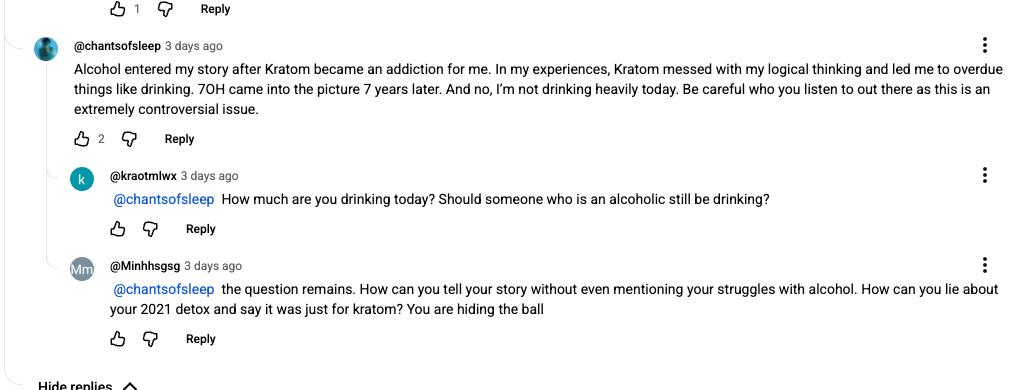
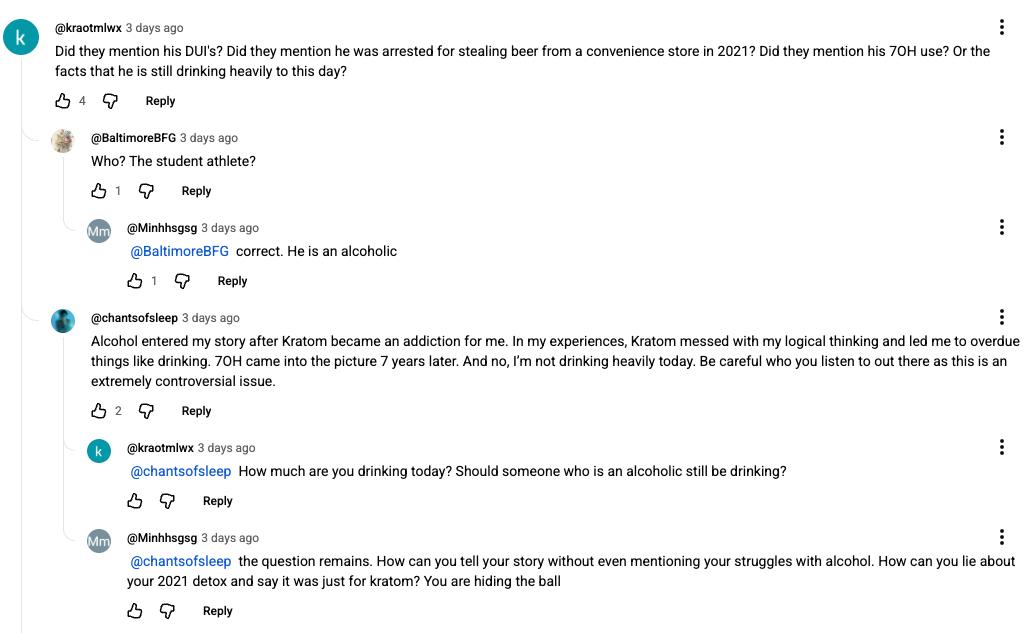
Most media reports exclude Cameron's history with alcohol. The End Kratom Addiction campaign often ignores it.
After Cameron's hit-and-run, his doctor prescribed him Naltrexone. Usually prescribed to treat alcoholics.
Dean has changed the story about Cameron's product use. But prior statements hint at Cameron abusing many different substances.
Dean has changed his story multiple times. He is on record stating Cameron had to seek help because of synthetic 7-OH. The escalation path — natural leaf → MIT extract bottles → concentrated 7-OH tablets — is on the family's own audio record, not just in plaintiff filings.
Cameron's timeline contains a performance dropoff before his supposed discovery of kratom. At that point, alcohol abuse was already confirmed — including by his girlfriend disagreeing with it. A fall-out with a coach came shortly after, and then the documented arrests from this period center on alcohol, not kratom.
The FDA Commissioner himself has said kratom has been traditionally used and is not the target of federal action. The 7-OH action targeted concentrated products — not natural leaf. Dean's testimony repeatedly collapses these categories into one word.
Millions of people use natural kratom in America, and the leaf has been used traditionally for hundreds of years. Real-world experiences — in the tens of thousands — align with peer-reviewed research showing a profile that is fundamentally different from oxycodone or heroin. A single family's experience cannot be inflated into a population-level claim.
Dean is leaving out Cameron's troubled past with alcohol. His stated reason for starting was to stop drinking at college parties — but he never stopped. His drinking resulted in multiple arrests and a hit-and-run. His doctor even prescribed him Naltrexone because of his heavy drinking. After all that, in 2025, Dean says a vape-store employee tricked his son into trying 7-OH by calling it a "new kratom."
The press-release line says plain leaf. The recorded audio says MIT-style extract bottles and concentrated 7-OH tablets. Dean has since switched his public position after seeing how much more impactful it is to conflate all the products into one category that can be banned together.
Was the product natural leaf, liquid extract, or concentrated 7-OH? Was alcohol involved? Were there legal or treatment-history factors? Would the proposed law actually target the products involved? A grieving parent can be sincere and still point lawmakers at the wrong target.
The EKA origin story says Cameron started using a substance to feel social without drinking — a young man who needed a chemical aid to get through an ordinary social situation. He told The Epoch Times: "Anytime I felt judged… it made me want to dive deeper into addiction." That is a documented cycle of substance abuse — judgment driving someone deeper into a substance — narrated by the person living it. Social anxiety and alcohol-use disorder are documented to travel together for exactly this reason. We are not diagnosing anyone, but the father's claim is contradicted by the way his son describes his own life. Was it a coping mechanism?
On the authenticated April 1, 2026 911 call, Dean says Cameron "literally walked into our house with a whole bottle of whiskey," had "alcohol all over him," and "downed an entire bottle" — while denying he drank. Yet Dean repeatedly tells the dispatcher it was 7-OH, with no test and no proof on the call. The recording documents whiskey; the father kept saying 7-OH. It is the whole campaign in one phone call.
When fear becomes policy, policy becomes a market. There is a litigation market, a consulting market, an advocacy market, a media market — and every market needs a story. The story being sold is simple. The records are not.
Press GO to begin the route, or tap any stop to jump in. The Kolodny file is complete. The other three are in progress — sections in development.
—
This is not a PDF graphic. It is an interactive evidence dashboard. The viewer should walk through four ideas: the spike is real · the product category is blurred · the denominator matters · most severe stories are not clean single-substance stories.
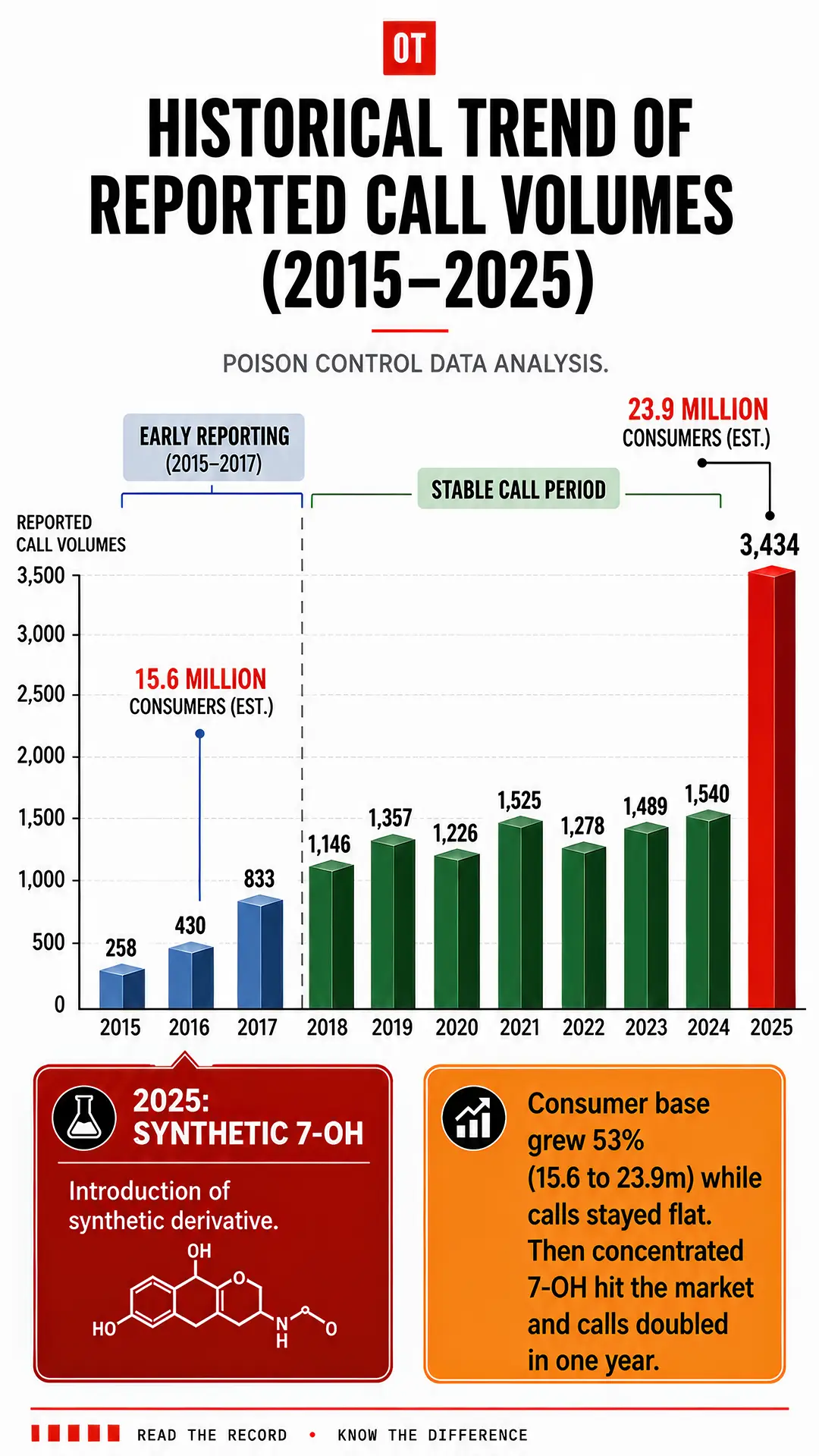
Reported kratom exposure calls, 2015–2025. CDC's 2026 NPDS analysis: 258 reports in 2015 · 3,434 in 2025 · plateau across 2020–2024 · marked surge in 2025 coinciding with high-potency semisynthetic formulations including 7-OH.
Reports begin to surface in poison-control data.
Average ≈ 1,366 reports per year. Consumer estimate grew ~53% during this window — calls did not.
3,434 reports — more than double 2024. Coincides with concentrated 7-OH market shift.
This is one of the most important forensic points in the entire Open Truth project.
If a death narrative depends on the idea that someone consumed a massive amount of natural kratom leaf, the body should often show some physical evidence of that story.
Natural leaf is not invisible. Powder has mass. Capsules leave "ghost pills." Huge botanical loads should leave some kind of gastric footprint.
In Brower's NMS presentation, he describes a different pattern. Across hundreds of kratom-related death discussions with pathologists, these cases often do not look like classic opioid overdose deaths — and they also do not show huge amounts of kratom material, capsules, green sludge, or coagulated gel-cap masses in the stomach. Instead, he says they are "usually pretty empty inside."
That does not prove kratom was never involved. It proves something narrower and more important:
A high mitragynine number does not automatically prove a massive natural-leaf overdose.
The physical record still has to match the story.
Blood numbers are not enough.
The stomach has to make sense too.
Brower's talk is useful because it cuts both ways. He does not say kratom is harmless. He does not say mitragynine can never matter. He does not say high concentrations should be ignored. In fact, he says that once mitragynine is above 500 ng/mL, he starts thinking about it as a possible contributor with other drugs, and above 1,000 ng/mL, he starts thinking about it as a possible cause of death — but he immediately qualifies that by saying it does not necessarily mean it is the cause of death and that investigators must consider the totality of the case, autopsy findings, and investigative evidence.
That is exactly the Open Truth standard. Not denial. Not panic. The full record.
The NMS evidence does not support lazy conclusions in either direction. It does not say kratom is harmless. It does not say every high mitragynine case is innocent. But it does destroy the simplest prohibitionist shortcut:
That is not forensic science.
A serious death investigation has to ask:
That is why Open Truth reads the record.
The evidence does not say "ignore kratom."
It says: stop pretending every kratom label means natural leaf.
Raw call totals can alarm. Relative call rates explain. When the data is normalized per 100K users, the viewer sees where kratom sits in the broader landscape rather than treating every raw count as equal. Click a year to scrub the data.
Kratom-involved death reports, 2019–2022. Each bar shows the composition: multi-substance use · other circumstances or needs more information · no additional factors documented.
CDC reports hospitalizations were consistently higher in multiple-substance exposure reports than single-substance reports, serious outcomes were also higher, and multiple-substance reports accounted for 184 of 233, or 79%, of kratom-associated deaths.
What share of 2025's reports involved concentrated or semisynthetic products?
What share involved adulterated or contaminated products?
What share of severe outcomes involved single-substance natural-leaf use only?
What regulation actually targets the risk drivers — without criminalizing the rest?
Poison-control calls rose sharply in 2025. That matters. But the same data environment also shows a changed product market, unresolved product-form categories, and severe outcomes tied heavily to multiple-substance exposure reports.
A chart that cannot separate natural leaf from concentrated 7-OH cannot honestly be used to justify a natural-leaf ban.
The answer is not panic. The answer is product separation, co-drug context, denominator math, and targeted regulation.
KDA presents itself through family loss, personal testimony, and public warnings. The grief is real. Open Truth is not investigating grief — it is investigating what happens when grief is converted into legislative proof.
The most powerful anti-kratom testimony rarely begins with data. It begins with a mother. A father. A photograph. A story about a product bought legally. A sentence like: "No one warned us."
That testimony moves rooms. But policy cannot stop at the room. It must go back to the record.
A family searches for a reason.
A complex death becomes "kratom." Co-drugs disappear. Pathology disappears.
Organizations give grief a target, a script, a petition, and a policy ask.
Lawmakers are asked to choose between grieving parents and "the kratom industry."
Natural leaf, extracts, synthetics, contaminants, and 7-OH are collapsed into one ban.
They protect the living from bad law.
Follow the route. Each stop opens a record — the public narrative on one side, the toxicology, pathology, and timeline on the other. Press GO to begin, or tap any stop to jump in.
—
They say kratom.
The toxicology panel does not report a mitragynine amount. NUMBER NOT REPORTED
The most important number is missing.
The official Tarrant County Medical Examiner record ruled Wyatt's death combined toxic effects of mitragynine, doxylamine, hydroxyzine, and sertraline — not "kratom overdose."
The forensic toxicology panel reports mitragynine and 7-hydroxymitragynine as positive, but does not report a numeric concentration for either. The same panel quantifies seven other substances with specific blood levels.
That gap matters. A positive screen is not a quantified finding. And the broader drug picture on this record — sedating antihistamines, an SNRI, a high DXM level, active THC, and amphetamine — is the picture the campaign slogan leaves out.
And the same autopsy contains a paragraph the public campaign has never quoted. It records a prior accidental overdose on fentanyl and cocaine, a prior kratom episode with possible overdose and seizure-like activity, and a comorbid asthma and anxiety history. The phrase a paragraph the public campaign has never quoted resolves in the next module.
Patti Wheeler's grief is real. Her advocacy is public. But the record is more complicated than the campaign slogan.
Patti Wheeler has cited the Tarrant County Medical Examiner's report at every legislative hearing and in every television appearance where she has appeared as her son's advocate. The document she has cited contains a paragraph she has never read aloud. We are reading it now.
What follows is not a leak. It is not a defense reinterpretation. It is not a competing expert's theory. It is a single sentence from the medical examiner's report on Wyatt Wheeler, written by the pathologist who examined his body, on the official letterhead of the Tarrant County Medical Examiner's Office, case number 2219485, in 2019. The Wheeler family has had this paragraph in their possession from the day the report was finalized. Their attorneys have had it. Every reporter who has covered the case has had access to it. The producers who put Patti Wheeler on television could have read it. State legislators who have heard her testify in support of kratom-restriction bills could have read it. None of them appear to have pointed at what it actually says.
We are pointing at it now. Verbatim.
"He was transported to Texas Health Fort Worth Hospital and pronounced [...] minutes after arrival to the emergency department. He has a reported history of a prior accidental overdose on fentanyl and cocaine, prior Kratom use with a possible overdose and associated seizure-like activity, asthma, and anxiety."
The medical examiner did not record this as a healthy young man killed by a natural plant. The medical examiner recorded it as a young man with a documented prior overdose on two of the most dangerous illicit drugs in the country, a prior episode with kratom serious enough to involve seizure-like activity, and a comorbid respiratory and anxiety profile. That is the history that walked into the emergency room. The campaign slogan walked in years later.
Three facts sit inside this single autopsy paragraph. Each one is documented. Each one has been omitted from every public Wheeler appearance for six years. Each one changes the meaning of everything the campaign has said since.
The first fact is the prior accidental overdose on fentanyl and cocaine. Fentanyl is the leading driver of overdose mortality in the United States. Cocaine is a Schedule II stimulant with documented cardiac toxicity. A previous near-fatal episode involving the combination is not a footnote in a medical history. It is, in any clinical setting, the kind of fact that places a patient in a different risk category from a patient without it. The medical examiner records it at the top of the patient's reported history. The public version of the story does not record it at all.
The second fact is the prior kratom use with a possible overdose and seizure-like activity. Wyatt did not encounter kratom for the first time on the day he died. He had, by the medical examiner's own language, a prior episode characterized as a possible overdose with associated seizure-like activity. That earlier event — whatever its exact pharmacology, whatever product was involved, whatever co-substances were present — sits in the record. Normal consumers, using natural leaf at typical serving sizes, do not generally have prior possible-overdose events on file. The presence of one raises a question the campaign's framing does not address.
The third fact is the comorbid asthma and anxiety. Asthma is a respiratory condition that complicates the use of any substance that touches opioid receptors. Anxiety in a young man with a documented history of overdose on illicit drugs rarely travels alone — it is almost always accompanied by patterns of substance use, often self-medication, sometimes with prescription co-medications that themselves complicate toxicology. The seven quantified substances in Wyatt's femoral blood specimen are not the toxicology of a recreational kratom user. They are the toxicology of someone with a complicated, ongoing relationship with pharmaceuticals and dissociatives.
The Wheeler campaign has built itself on the premise that the public should trust the medical examiner. We agree. This block is the public trusting the medical examiner.
The Wheeler narrative has been carried into multiple state legislatures, into national television, and into the broader public conversation as a kratom-only tragedy. None of that public framing has included the paragraph quoted above. The autopsy is what the autopsy is. It is in the record. The next person who hears Patti Wheeler describe her son's death as a kratom-only event — at a state legislative hearing, on television, in any forum — is entitled to ask one question.
The autopsy of Wyatt Wheeler documents, in the medical examiner's own words, three pre-existing facts that the public campaign has omitted from six years of testimony, interviews, and litigation:
The combination is the deadliest illicit pairing in American drug surveillance.
By the medical examiner's own language. Wyatt's history with the substance did not begin on the day he died.
Both materially affect how the body responds to any opioid-receptor-active compound.
"Combined toxic effects" is not the same as "kratom alone."
The public was told one name. The lab found thirteen. Twelve of those findings got a number on the report. The one that didn't is the one the headline made famous.
Named as the cause. Never measured. Every other finding on this panel that mattered got a number. Mitragynine got a checkbox. Without a concentration there is no dose, no threshold, no comparison, and no scientific basis for naming it the killer. The most-cited substance in the public story is the least-documented finding on the report.
NO LEVEL REPORTEDCough-syrup ingredient at a recreational-abuse level. DXM at this concentration causes sedation, dissociation, and serotonergic effects that stack with every antidepressant and antihistamine on this page. A number this size on its own can drive a medical examiner's combined-cause ruling. It did not drive the headline.
POTENTIATION · ELEVATEDActive stimulant detected in femoral blood. Amphetamine drives heart rate, blood pressure, and cardiac stress at the same time the sedating antihistamines and SSRIs in this panel are suppressing respiratory and serotonergic systems. The body is being pulled in two directions at once. That is a cardiac-event profile. It is not a kratom profile.
STIMULANT · CARDIAC LOADThirteen findings. One headline.
Three substances at elevated, synergistic concentrations — doxylamine, hydroxyzine, sertraline — were detected alongside DXM at 442 ng/mL and active amphetamine. The medical examiner's own language was combined toxic effects. The public story named one of the thirteen.
Mitragynine was part of the case. It was the only finding never measured.
The dangerous finding was the mix.
Eight substances were quantified or detected in Wyatt Wheeler's autopsy. We took all eight, looked up how many times Americans reported each one to a poison center in a single year, and sorted them. The substance named in his cause of death finishes last. Not close to last. Last.
This is the simplest test on this entire page, and it requires no toxicology training to read. The 2022 National Poison Data System — the federal surveillance database every U.S. poison center reports into — records how many times each substance prompted a call. It is a measure of real-world footprint: how often a substance lands a real person in a real poisoning conversation. We pulled the number for every substance found in Wyatt's body. Then we put them in order. The order tells a story the headlines never did.
2022 National Poison Data System — calls reported per substance. Federal surveillance data.
1,278 calls. Eight of eight. The substance they blamed is the substance America reports the least.
Every other substance in Wyatt's toxicology generated more poison-center contact than kratom — most of them many times more. Diphenhydramine, the over-the-counter antihistamine in countless medicine cabinets, generated more than thirty times as many. The cough suppressant found at 442 nanograms in his blood generated nearly ten times as many. Even doxylamine — the sleep-aid antihistamine sitting one rung above kratom on this chart — was reported almost five times as often.
There is a reason for this, and it is not the reason the campaign offers. Kratom has a smaller national footprint because, used the way the overwhelming majority of consumers use it — natural leaf, measured servings, no concentrates — it sends very few people into a poisoning crisis. The substances that fill the rest of this chart are the ones that actually drive Americans to pick up the phone. They are also the substances that filled most of Wyatt's toxicology report. One of them was present at a level the medical examiner could measure. Kratom was present only as a word: positive, never quantified.
Each substance tile below was named in the medical examiner's ruling or appeared at elevated concentration in the panel. The official cause is the sum — not any single tile.
The medical examiner used combined-cause language for a reason.
Wyatt's record includes DXM at 442 ng/mL, along with elevated sedating antihistamines and mitragynine. DXM is widely discussed in online drug communities as a potentiator in combination with other psychoactive substances. The official report does not prove intent on its own, but the toxicology pattern raises a clear public-health issue: this was a multi-substance interaction risk.
The issue is not one substance in isolation. The issue is the interaction environment.
A potentiation pattern should not be rewritten as a plant-only death.
Doxylamine. Hydroxyzine. Diphenhydramine. Three antihistamine-related signals in one case.
In isolation, some of these substances may not tell the full story. In combination, they matter. Sedating antihistamines can add central nervous system depression, anticholinergic burden, impaired protective reflexes, and cardiac stress. When layered with mitragynine, DXM, sertraline, THC, and amphetamine, the record becomes much more complex than a kratom headline.
Co-factors are not footnotes in a combined-drug death.
Seizure-like collapse and autopsy findings consistent with a complex central-nervous-system and respiratory-depression scenario.
A seizure-like event does not automatically prove kratom-alone causation. The question is: What was in the system? What substances were elevated? What combinations were present? What vulnerabilities existed? What did the medical examiner actually rule? The official answer was combined toxic effects.
The collapse was real.
The single-cause story is not.
Wyatt's autopsy documented mild cardiomegaly with mild myocyte hypertrophy, along with overweight BMI and mild fatty liver. As established in Module 01B, the same record also notes asthma, anxiety, and prior substance-use context. Each of these factors interacts with the toxicology in its own way. This module focuses on cardiac vulnerability specifically.
This does not mean heart disease alone caused Wyatt's death. It means the body had less room for error.
That is why the medical examiner's combined-cause language matters.
Vulnerability changes the risk of the mix.
But the official record does not make it the whole case.
Mitragynine was elevated and included in the cause-of-death language. That should be acknowledged plainly.
But the medical examiner did not rule a simple mitragynine-only death. The official cause was combined toxic effects of mitragynine, doxylamine, hydroxyzine, and sertraline.
Included is not isolated.
Elevated is not alone.
Those risks call for better warnings, better regulation, and better education — not turning every kratom-related tragedy into an argument against natural leaf.
Regulate the real risk.
Read the autopsy. Read the toxicology. Regulate the real risk.
Wyatt deserved the truth.
The public deserves the complete record.
Christopher James "CJ" Holowach's death was tragic. His family's grief deserves compassion. But grief is not the same thing as proof. And a memorial bill should not outrun the medical record.
CJ's Law is being promoted as a kratom tragedy. The official record is more complicated.
The medical examiner did not certify a clean "kratom overdose." The cause of death was mixed drug intoxication including mitragynine, with hypertensive cardiovascular disease listed as a contributory factor.
The toxicology was not empty. It included mitragynine alongside amphetamine, bupropion, hydroxybupropion, diphenhydramine, meprobamate, THC context, and urine presumptive positives.
That record may justify warnings. It may justify testing. It may justify product-form separation, age gates, interaction education, and targeted regulation.
But it does not justify pretending the autopsy said kratom alone.
Christopher James "CJ" Holowach's death was tragic. His family's grief deserves compassion.
But the policy question is not whether the grief is real. The policy question is whether the record supports a natural-leaf ban.
The medical examiner did not write "kratom overdose." The cause was mixed drug intoxication including mitragynine, with hypertensive cardiovascular disease listed as contributory.
That is not a clean kratom-alone record. It is a mixed-drug, cardiovascular-vulnerability record — and lawmakers should not turn that into a slogan.
"Including mitragynine" is not the same as "kratom alone."
Multiple active substances. One simplified headline. The femoral blood toxicology showed a mixed profile of central-nervous-system active substances.
This is not a one-substance record. The key issue is not one isolated number — the key issue is the combination. Stimulants can increase cardiac strain. Sedating substances can impair protective responses. In a person with documented cardiovascular disease, that mixed profile matters.
The dangerous finding was the combination — not one plant in isolation.
The autopsy listed cardiovascular disease because it mattered.
An enlarged, hypertensive heart is already under strain. Add substances that may increase cardiac workload. Add sedating substances that may blunt protective responses. Add a sudden collapse within a short time window. Add multiple active compounds.
That is a very different story than "kratom killed him."
The heart disease was not a footnote.
It was listed as contributory.
Elevated. Relevant. Not a stand-alone verdict.
CJ's mitragynine level was 1,000 ng/mL. That number belongs in the discussion.
But the medical examiner did not write a simple "kratom overdose" finding. The official wording was mixed drug intoxication including mitragynine. That wording matters.
The public claim names one cause. The autopsy shows several. The autopsy gives a mixed record. Mitragynine was part of the case. It was not the whole case.
Elevated does not mean independently fatal.
CJ's Law turns a complicated death into a simple policy demand. But the official record does not support that simplification.
That is not a clean natural-leaf overdose story. It is exactly why lawmakers should slow down before turning grief into criminal policy.
Bad policy begins when a complicated record becomes a slogan.
CJ's death should lead to better public-health policy — not broader category collapse.
Those risks do not justify collapsing natural leaf, extracts, adulterated products, and concentrated 7-OH into one criminal category.
Regulate the real risk.
Read the record. Separate the products. Regulate the real risk.
CJ deserved the truth.
New Jersey deserves the full record.
Three nonprofit and advocacy groups have shaped the public framing of kratom. Their messaging strategies, sources of funding, and policy positions are documented below.
You are about to read about three organizations whose entire public reason for existing is built on the death or addiction of someone they loved. That grief is real. We are not here to argue with it. We are here to tell you what every single one of these stories has in common — and it is not what the headline says.
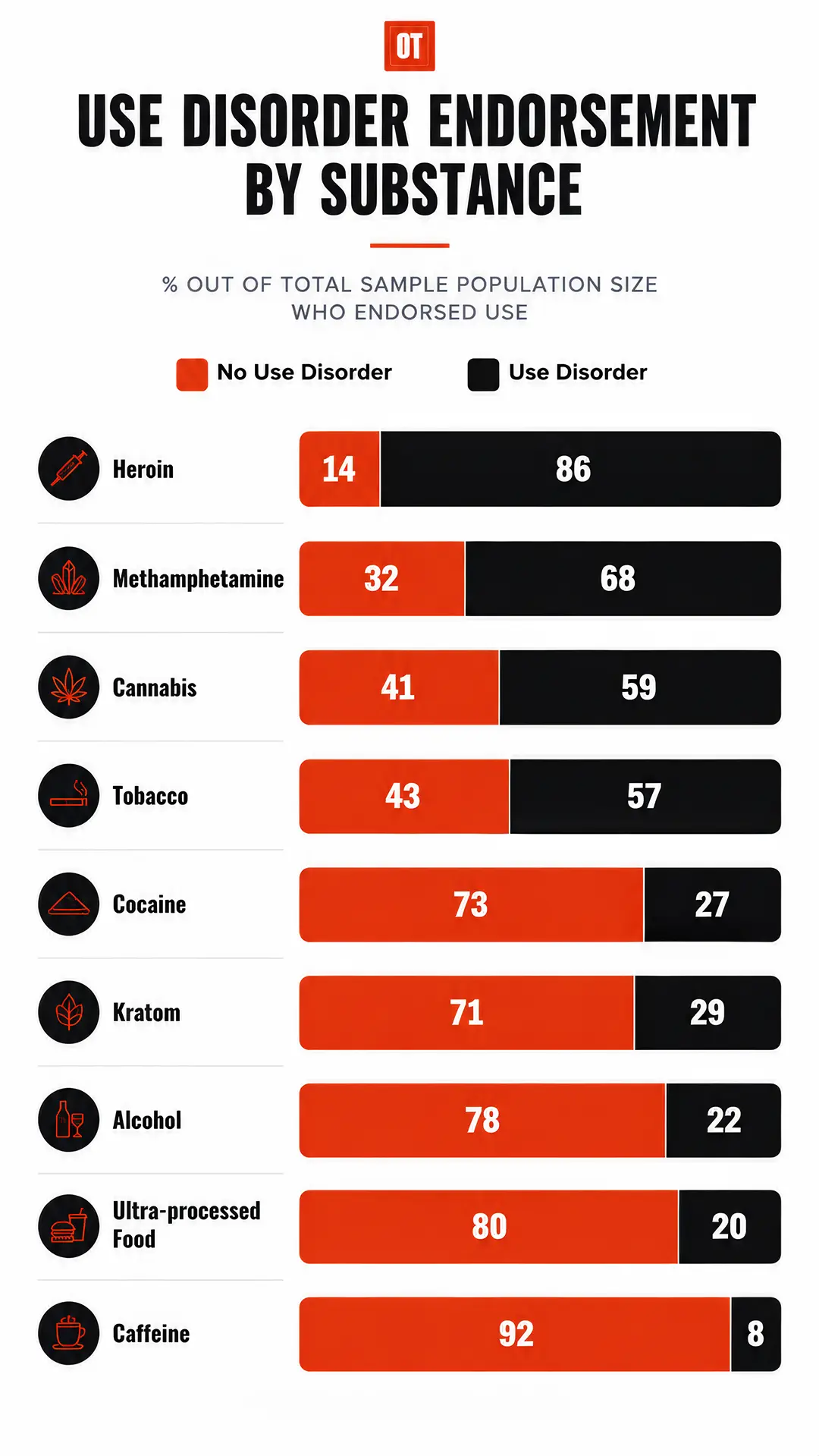
Natural kratom leaf has been used for centuries across Southeast Asia. It is consumed daily, in measurable amounts, by millions of American adults. The federal scientific record — FDA, NCCIH, peer-reviewed toxicology — says the same thing in different words: kratom-alone fatal overdose appears to be extremely rare, and the deaths the public hears about almost always involve other substances, pre-existing disease, or a concentrated extract product that is not the leaf at all.
We have read every public death narrative and every public addiction-survivor account we could find. Every single one has a confounder. A fentanyl screen. An antidepressant. An antihistamine at lethal concentration. A diseased heart. A 7-hydroxymitragynine shot bought at a gas station. A liquid extract. An undisclosed alcohol problem. A pattern of escalation. Something.
Even the Executive Director of the most active anti-kratom organization in the country has admitted, in writing on the public record of the Virginia House of Delegates, that her own worst medical emergency came from the 7-hydroxymitragynine concentrate — not from the leaf the organization she runs is fighting to ban. That admission is exhibited later on this page. Read the rest of this block first.
We could not find a single case — not one — where natural kratom leaf, by itself, in a measured serving, killed an otherwise healthy adult. The same pattern holds for the most cited "ruined my life" stories. In the cases we reviewed, the record points to a concentrate, a co-substance, or an underlying condition. The grief is not the question. The story being told about the grief is the question.
Every kratom harm story you have heard has something else in it. That is not a coincidence. That is the pattern.
that was never read on camera.
that is not the natural leaf — usually a concentrated extract, a 7-OH shot, or a liquid tonic.
— daily abuse, mixing with prescriptions, managing an untreated condition, escalation to a more potent product — that no responsible adult consumer would recognize as their own.
The next thing every one of these stories has in common is the dose. If you ask a regular kratom consumer in the United States how much leaf they use, the answer is almost always the same. A typical serving is somewhere between two and five grams of plant material. A typical day is somewhere between two and fifteen grams total. That is the entire range of normal use. At those amounts, the published toxicology forum work — Huestis and colleagues, 2023 — says moderate daily use of unadulterated leaf powder generally does not produce a significant withdrawal syndrome, and the global pharmacological literature places those amounts comfortably inside the safe consumption window that Southeast Asia has held for centuries.
That is not who you hear about.
The people testifying in front of legislatures, posting confessional videos, and writing op-eds about how kratom destroyed their lives are almost never describing two to fifteen grams of natural leaf a day. They are describing 50 grams. 80 grams. 100 grams. They are describing concentrated liquid extracts — bottled shots, gas-station tonics, isolated 7-hydroxymitragynine products — that have nothing pharmacologically in common with the leaf they are blamed on. They are describing patterns of use that any responsible adult, with any other substance — caffeine, alcohol, ibuprofen, melatonin — would also recognize as abuse.
And there is almost always more underneath it. A diagnosed mental health condition someone tried to medicate without help. A chronic pain situation they could not get a doctor to take seriously. An undisclosed addiction history. A postpartum crisis. A trauma they were running from. A pattern of escalation that led, eventually, off the leaf and onto something stronger.
These are real situations. They deserve real compassion. They do not justify a ban on a plant that, used the way the overwhelming majority of consumers use it, is one of the most boring things in the supplement aisle.
Press GO to begin the route, or tap any stop to jump in. Each stop opens its own dedicated file.
—
KDA presents itself through family loss, personal testimony, and public warnings. The grief is real. Open Truth is not investigating grief — it is investigating what happens when grief is converted into legislative proof.
KDA serves as the family-advocacy bridge between individual losses and the broader prohibition ecosystem. Grieving families are placed at the microphone. The policy machine — expert framers, prohibition coalitions, litigation networks — moves behind them.
Personal testimony cannot answer the toxicology questions. It cannot separate natural leaf from concentrated 7-OH. It cannot identify co-drugs. It cannot establish single-substance causation. Those questions belong in the autopsy and the toxicology panel — not in a grief narrative.
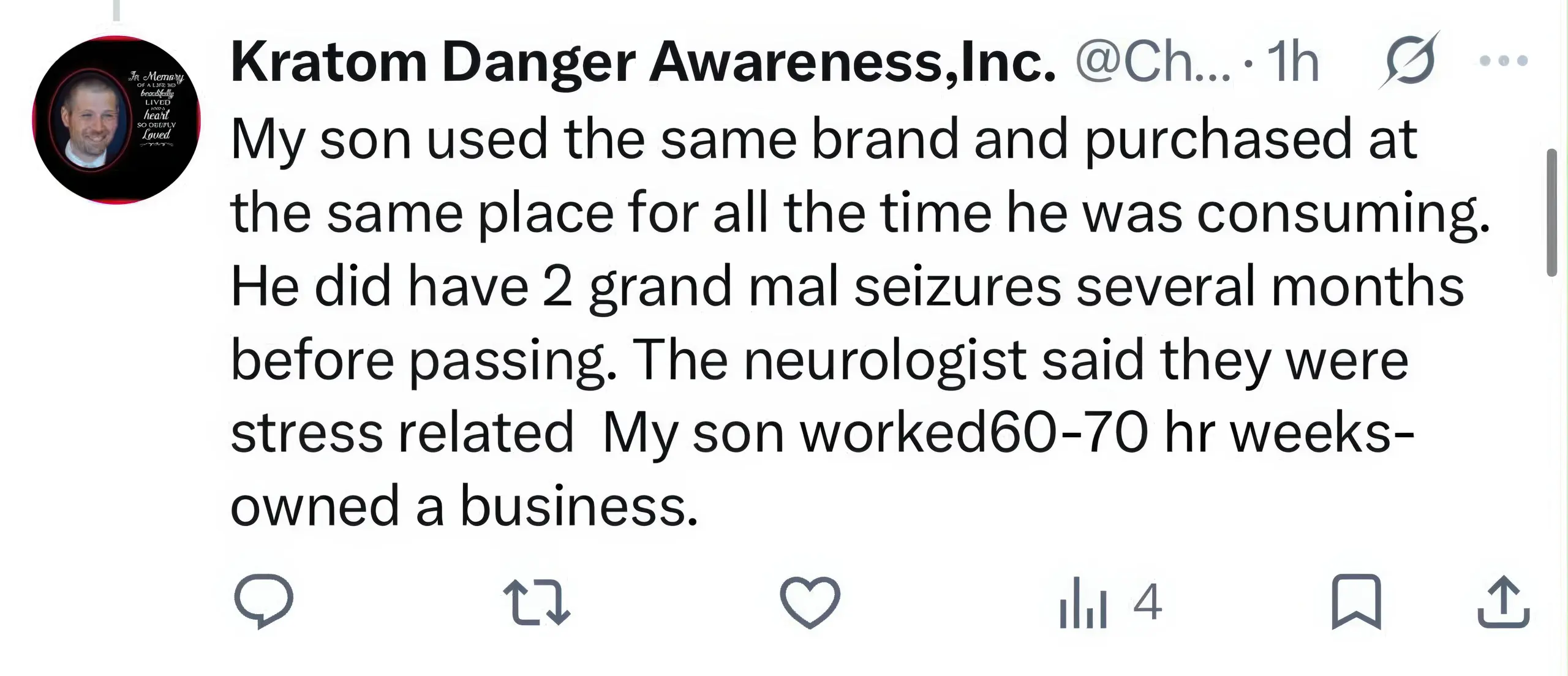
Kratom Danger Awareness exists because Wendy Chamberlain's son, Joseph S. Lumbrazo, died on August 30, 2020, at the age of thirty-eight. He was her son. The grief is real. The organization she built afterward is real. The question this block raises is not whether her loss happened. It is whether the explanation she has settled on for that loss is the one the evidence actually supports.
A plant that has been used safely across Southeast Asia for centuries, that the federal scientific record describes as producing kratom-alone fatal overdose at vanishingly rare rates, that millions of American adults consume in measurable daily amounts without incident — this is the substance Wendy Chamberlain has publicly identified, again and again, as the murderer of her son.
Her son's underlying medical examiner record has not been publicly released. Times Union reporting later described Joseph as a daily powder user whose mother only afterward came to recognize what she called "an apparent addiction." A wrongful death lawsuit, CHAMBERLAIN v. ANAND CORP., was filed in Oneida County, New York in 2022 against the smoke shop that sold him the product. Her public narrative about the cause of his death evolved over time —
That is not a small shift. That is the entire foundation of an advocacy organization moving into place.
This is what most grieving parents do. Public campaigns often search for a single, simple cause because the complex reality of polypharmacy and substance use is difficult to communicate. We understand this. We are not asking Wendy Chamberlain to bear the unbearable on camera.
We are asking the legislators who listen to her to remember that the most sympathetic witness in the room is not the same thing as the most informed one.
The woman state legislators have invited to testify on the dangers of a botanical product, and whose grief has been treated as the moral center of multiple statehouse hearings, has two open criminal cases in New York that have not been publicly addressed by KDA or by the lawmakers who have platformed her. We are not declaring her guilty of anything. She has pleaded not guilty to every charge. The arraignments are a matter of public record. We are asking a simpler question: when you are deciding who to trust on a question of public health, does this record belong in the room?
The cases are summarized below as the court filings present them. No more, no less.
The Executive Director's own testimony, in writing, on the public legislative record. Read what she said before you read what the organization argues.
End Kratom Addiction was founded by Dean Francis, a Virginia father, after his son Cameron's eight-year struggle with substance use. The organization's day-to-day operations are run by an Executive Director named Hilary Tesluck, who is, by the organization's own description, the credibility asset of the entire campaign — her firsthand addiction story is what EKA's own About page says gives the group its "sharp conviction." Before you read anything else about EKA, you should read what Hilary herself has said, on the public legislative record, about the difference between natural kratom leaf and concentrated 7-hydroxymitragynine. She drew the distinction. We are just pointing at it.
EKA's homepage attributes this statement to Hilary Tesluck, under the title VP / Co-Founder Kratom Quitters, Certified Peer Support Specialist:
Kratom addiction is real, and so is the pain and suffering that goes with it. Tens of thousands of people, and all their families, are facing a crisis that never should have happened. This industry chose to side-step safeguards to maximize a profit, and now attempts to blame the users. It was preventable then, and it is preventable now. The good news is that we are no longer suffering in isolation. We've organized, and our collective voice will be heard.
That is the public-facing claim. One substance. One industry. One blame. The substance is described as if it were a single thing. The category is not subdivided. The leaf and the concentrate are presented as the same problem.
Now read what she actually wrote in a courtroom-adjacent setting where her words are under her own name on the official record.
On February 4, 2026, Hilary Tesluck submitted written public comment to the Virginia House Agriculture Subcommittee in support of HB360 — a bill requiring opioid-style warning labels on kratom products and moving them behind retail counters. Her testimony, filed under "Tesluck — Organization: End Kratom Addiction — Locality: Charlotte, NC," is in the official record of the Commonwealth of Virginia. In her own words:
My name is Hilary Tesluck and I have direct lived experience with both kratom and 7oh addiction.
Today, I am clean, but I will never forget the true nightmare of withdrawing from kratom and 7oh. Both things I consider to be the most difficult things I have done in my life. It is NO DIFFERENT than prescription opioid withdrawal. In fact, I find it worse.
Withdrawing from kratom leaf produced a lengthy post-acute withdrawal syndrome in which I experienced profound depression for 90 days.
Withdrawing from 7oh was terrifying because I did it cold turkey on my own (I didn't have access to resources like rehab) and it was so intense I ended up going to the ER because I thought I would pass out alone in my apartment. I couldn't walk, couldn't shower without the risk of fainting. I thrashed day and night for six days total. It is worse than heroin withdrawal because it's so strong.
Read it slowly. The Executive Director of End Kratom Addiction, on the official record of a state legislature, draws an explicit line between two substances. The leaf gave her depression. The concentrate sent her to the emergency room. The leaf was hard. The concentrate was, in her own words, worse than heroin.
That is the FDA distinction. That is the HHS distinction. That is the peer-reviewed pharmacological distinction. That is the distinction federal H.R. 8000 is built around. And it is the distinction the organization Hilary herself runs spends every day lobbying state legislatures to ignore.
A piece of testimony is also a piece of self-description. Read in that light, three lines in Hilary's statement ask questions she did not answer on the record — and that no one on the subcommittee asked her to.
Three months of clinical-grade depression following cessation of the leaf. Post-acute withdrawal syndromes of that depth and duration are not the typical response of a normal-dose, non-dependent consumer. They are the response of a body that had been using a substance to manage something it could no longer manage without it.
Was the depression caused by the leaf — or was the leaf being used to medicate a depression that was already there? At a normal serving size, two to fifteen grams a day, that level of post-cessation depression is not what the published research describes. It is, however, consistent with the cessation of a substance used to manage underlying depression.
An adult woman testifying that withdrawing from a leaf taken at recreational and recovery doses produced the most difficult experience of her life. Not the hardest substance experience. The hardest experience. Full stop.
What dose, sustained over what period, would have to be in play for an otherwise healthy adult to describe leaf withdrawal in those terms? The typical American consumer — two to fifteen grams a day — does not have that experience. The dose, the duration, and the dependence she is describing are not characteristic of normal consumption. They are characteristic of substance-seeking behavior — of a body chasing a feeling the leaf was no longer providing on its own.
A direct first-person comparison between 7-OH withdrawal and heroin withdrawal. The sentence is not framed as analogy or as something she read about. It is framed as experience.
Comparing a substance withdrawal directly to heroin withdrawal raises questions about the baseline of her experience. The phrasing — flat, declarative, unhedged — is the phrasing of someone reporting from inside both experiences, not the phrasing of someone making an analogy. The Executive Director of an organization arguing that natural kratom leaf is an opioid-class threat to the public is, on the same page of the same record, suggesting in her own words that her own substance history includes a comparison set heroin is part of.
None of the above is a diagnosis. None of it is an accusation. We are reading her testimony the way any investigator reads a witness statement — line by line, looking for what the line claims and what the line implies.
The line describes symptoms commonly associated with underlying conditions. The line implies a pattern of use far beyond what the literature describes as normal. The line implies a comparison set that includes substances the public version of her story does not name. The line implies all of this in her own words, on the public record of a state legislature, while the organization she runs argues to that same legislature that the substance she is testifying about is the same problem as the substance that put her in the ER.
The leaf was a chapter. The chapter implies a longer story. The longer story is the one the testimony does not tell.
On her public LinkedIn profile, in a post written approximately three months into her tenure as EKA's Executive Director, Hilary wrote:
"9 years ago, I was scared and ashamed to be addicted to a 'supplement.' I didn't know I wasn't the only one. Suffering from kratom addiction has given me newfound purpose in life. Would I go through it again knowing how everything turned out? Yes."
EKA's own promotional materials describe her experience this way, in language the organization itself selected:
"This led to a gripping addiction, horrifying withdrawal, and several years of agonizing recovery."
A nine-year arc. Several years of recovery. And — by her own testimony in Virginia — an escalation, somewhere along that arc, from natural kratom leaf into a concentrated 7-hydroxymitragynine product.
That is not the profile of a normal consumer. The typical American kratom user takes two to fifteen grams of leaf per day, for a defined purpose, and never escalates. Hilary's own description of her arc is something different. Nine years. Tolerance. Continued use despite consequences. Withdrawal at cessation. And then a crossover from the leaf into a more potent product when the leaf was no longer producing the effect she was looking for.
Escalation of dose, escalation to a more potent form of the substance, continued use despite consequences, withdrawal symptoms upon cessation.
We are not naming Hilary's condition. She has not been diagnosed in public. We are simply observing what her own words describe: a sustained pattern of substance-seeking behavior, across nearly a decade, that the leaf at normal serving sizes apparently could not satisfy. So she escalated. So she crossed over. So she ended up in the ER — from the concentrate, not the leaf.
This escalation is not characteristic of normal consumer behavior; it matches clinical criteria for substance use disorders.
Hilary Tesluck deserves the same compassion any person in recovery deserves. Her account is hers to tell, and the courage of telling it publicly is real. The argument here is not with her healing. The argument is with the organizational decision to take a story whose central medical crisis came from a concentrate, and whose underlying pattern is the textbook signature of a substance use disorder, and use that story to lobby state legislatures for laws that ban or restrict the leaf.
EKA's mission, in the organization's own words, is to end kratom addiction — described as a single, undifferentiated thing. Its Executive Director's testimony, on the public record, identifies 7-hydroxymitragynine as the substance that put her on her apartment floor and into the emergency room. The natural leaf was a difficult chapter of a longer story. The concentrate was the ER.
That is not our framing. That is hers.
The FDA drew that line in July 2025.
HHS drew it.
NCCIH drew it.
The H.R. 8000 federal kratom bill drew it.
Hilary Tesluck drew it in writing on February 4, 2026.
The only entity that refuses to draw it is the organization Hilary herself runs.
EKA was founded by Dean Francis after the long, documented decline of his son Cameron Francis. EKA's public testimony tells state legislatures that Cameron's life was destroyed by plain-leaf kratom powder. The public record tells a more complicated story.
Both EKA stories — the founder's and the Executive Director's — feature an escalation to a concentrate. Both are being used to argue against the leaf.
Smart Approaches to Marijuana built its brand fighting cannabis legalization. The same prohibition infrastructure is now moving toward kratom — the same playbook, the same messaging, the same scheduling demands.
Smart Approaches to Marijuana built its brand fighting cannabis legalization. Now the same prohibition infrastructure is moving toward kratom.
The move is not subtle. FDA drew a line between concentrated 7-OH products and natural kratom leaf. SAM's public statement rejected that line, arguing that both 7-OH and mitragynine are lethal.
SAM, FDPS, Kevin Sabet, and the professional prohibition network behind the new kratom panic.
Category collapse · expert framing. How a single expert turns a complicated public-health question into a one-word policy demand.
Kolodny's public argument works because every claim sounds obvious. But every "obvious" claim depends on leaving something out. Click any claim to open the evidence drawer.
Dr. Andrew Kolodny's kratom argument works because it sounds simple. Call kratom an opioid. Treat natural leaf like concentrated 7-OH. Treat dependence like heroin withdrawal. Treat poison-control calls like proof of leaf causation. Treat FDA warnings like a death verdict. Then land on the policy demand: ban it.
But that is not toxicology. That is category collapse.
Kratom is not risk-free. No serious policy discussion should pretend it is. Some people misuse it. Some products are contaminated. Some extracts are too strong. Concentrated 7-OH products deserve aggressive scrutiny. That is exactly why the distinctions matter.
Kolodny's argument skips those distinctions. Open Truth puts them back.
Hover any row to surface the source line behind the correction.
He is a physician and public-policy voice whose opioid framing carries weight with lawmakers, reporters, and local officials. That is exactly why the frame matters.
When a credentialed expert collapses natural leaf, extracts, 7-OH, poison-control calls, dependence, and rare death reports into one prohibition argument, that argument can move policy faster than the underlying science can correct it.
That is the danger. Not that Kolodny talks about risk. Risk should be discussed. The danger is that he turns risk into category collapse.
The problem is not that Kolodny talks about risk. The problem is that he turns risk into category collapse.
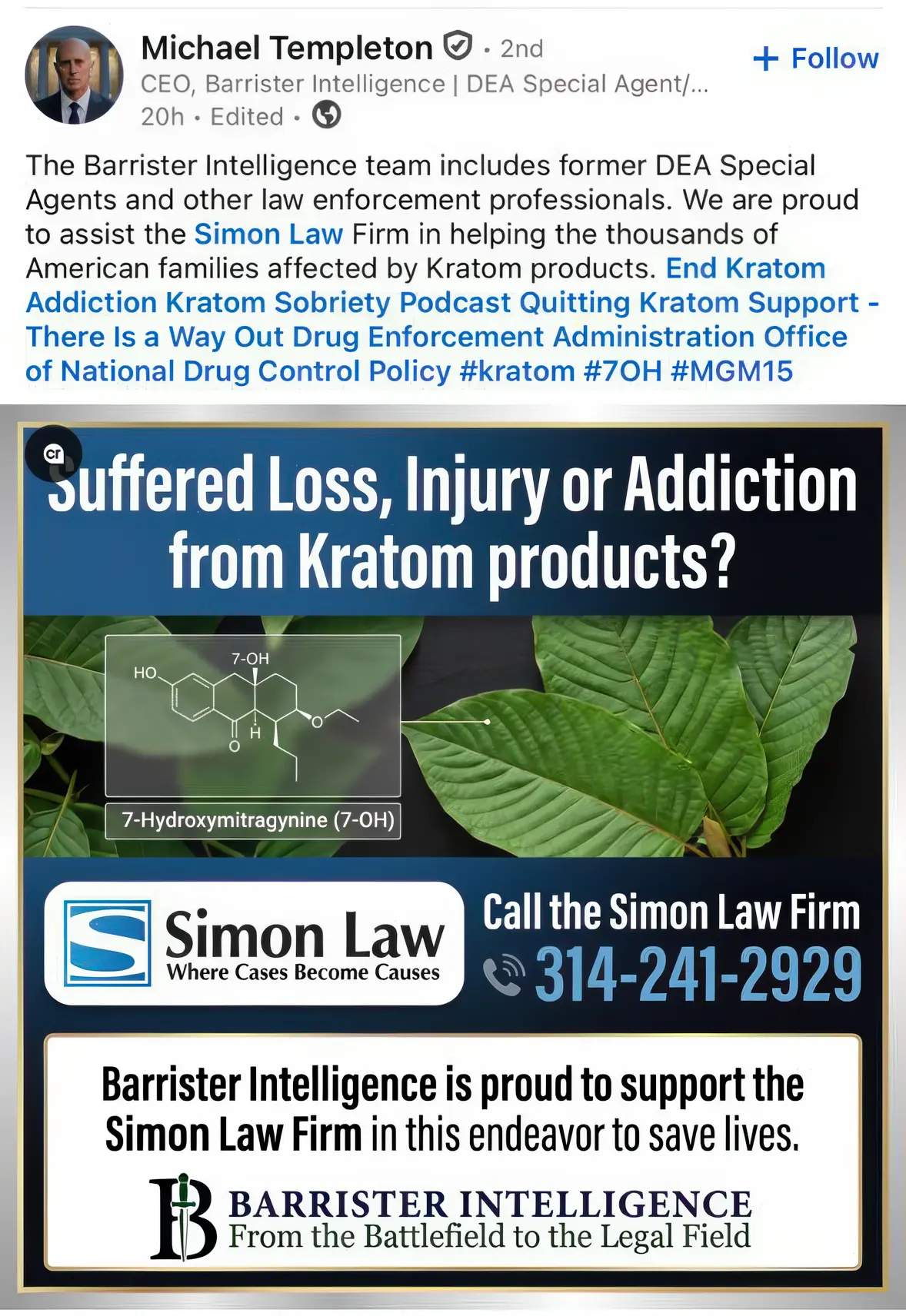
Barrister Intelligence · litigation support. From the battlefield to the legal field — when former drug-enforcement branding becomes a paid plaintiff-side service.
MCT Law · Hickey · et al. — the wrongful-death litigation economy. The Coyne verdict, the Talavera case, and the financial machinery behind seven-figure kratom-causation claims.
Wrongful-death litigation has become one of the most powerful engines in the kratom debate. That does not make every lawsuit false. It does mean the public should understand the incentives.
MCT Law publicly advertises kratom wrongful-death and severe-injury lawsuits against manufacturers, suppliers, distributors, and vendors. The firm publicized a $2.5 million verdict in the Patrick Coyne case.
A federal judge entered an $11.6 million judgment in the Krystal Talavera / Grow LLC case, according to litigation reporting.
Kratom attribution can turn a toxicology narrative into a lawsuit.
Cause-of-death classifications can affect insurance outcomes. The incentive structure deserves examination — case by case.
Prohibition campaigns need stories, donors, media, and political urgency.
Former law enforcement, policy experts, and litigation consultants gain relevance when a substance becomes the next public panic.
Open Truth does not claim every family is acting from money.
Open Truth claims the system around these stories has money in it. When money enters the record, the public deserves transparency.
Market rivalry · prescription economy. Who wins if kratom is banned — and why the opioid playbook keeps showing up in the kratom debate.
Pain, anxiety, opioid-use disorder, sleep. Each one is a major prescription category — and each one has consumers who walked off of a prescription and onto natural kratom leaf. Take the leaf off the shelf, and those consumers walk back. That is not a loss being recovered. That is a market being handed back.
Survey data has repeatedly found that many adults use natural kratom leaf in place of prescription opioids, NSAIDs, or muscle relaxants. Ban the leaf and those scripts come back. Every consumer who left the pharmacy aisle is a consumer the pharmacy aisle wants returned.
Other respondents report substitution for benzodiazepines, SSRIs, or off-label sedatives. Ban the leaf and those refills resume. Long-tenured products with shrinking adherence become long-tenured products with restored adherence.
Suboxone, methadone, and naltrexone are billion-dollar treatment categories. Natural kratom leaf is reported by some former-opioid users as a self-managed alternative — outside the medication-access economy entirely. Ban the leaf and that population re-enters the economy. A self-managed market becomes a managed-care market again.
The sedative-hypnotic market — zolpidem, eszopiclone, suvorexant, doxepin — is enormous. Ban the leaf and the consumers who left for it return to the script pad. Any consumer movement at scale matters to the underlying revenue model. Reversing that movement matters even more.
Open Truth is not claiming a secret pharmaceutical-industry conspiracy to ban kratom. The pattern is simpler and harder to dismiss: when a low-cost botanical begins to displace prescription revenue at scale, a ban does not restore equilibrium — it transfers a population back to the prescription economy. That transfer has a beneficiary. Naming the beneficiary is not an accusation. It is a question the public record deserves to ask.
The full Big Pharma file. Funding flows, prescription-substitution data, expert-witness disclosures, and the market geometry behind the kratom debate — read through the lens of who recovers, not who relinquishes.
The kratom fight is starting to look familiar.
This is not a conspiracy claim. It is a pattern analysis.
Open Truth is not alleging a proven direct payment scheme. We are examining how opioid-era public-health language, expert framing, advocacy pressure, litigation incentives, and market architecture can turn a complicated product category into a simplified policy demand.
Each row below appears across all three eras. Click any row to expand it and see how the same machinery shows up under different product names.
Once kratom is framed as simply "an opioid," the rest of the debate compresses.
That is how category collapse becomes policy.
The question is not whether kratom has risks. It does. The question is whether the people shaping the debate are separating those risks honestly:
That is where the next layer begins.